The Disposition Effect
« You have power over your mind — not outside events. Realize this, and you will find strength”
– Marcus Aurelius
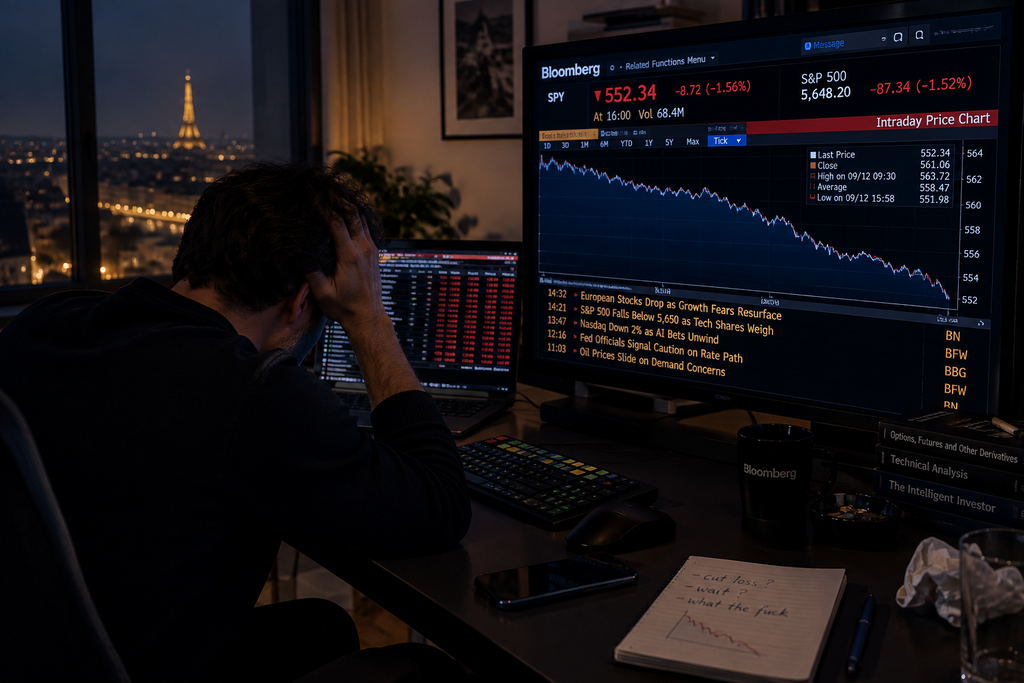
« Cut your losses. Let your winners run. » It’s the oldest rule in investing, repeated in every trading course and every finance book ever written. And yet, when researchers actually looked at how real people invest, they found the opposite happening, millions of investors doing the exact reverse of what they’d tell you to do if you asked them.
The Phenomenon, Empirically Proven
The proof isn’t anecdotal. In 1998, finance professor Terrance Odean set out to test whether this backwards behavior was real, or just a story traders told each other. He analyzed the trading records of 10,000 individual brokerage accounts, tracking exactly which stocks people chose to sell and which they chose to hold.
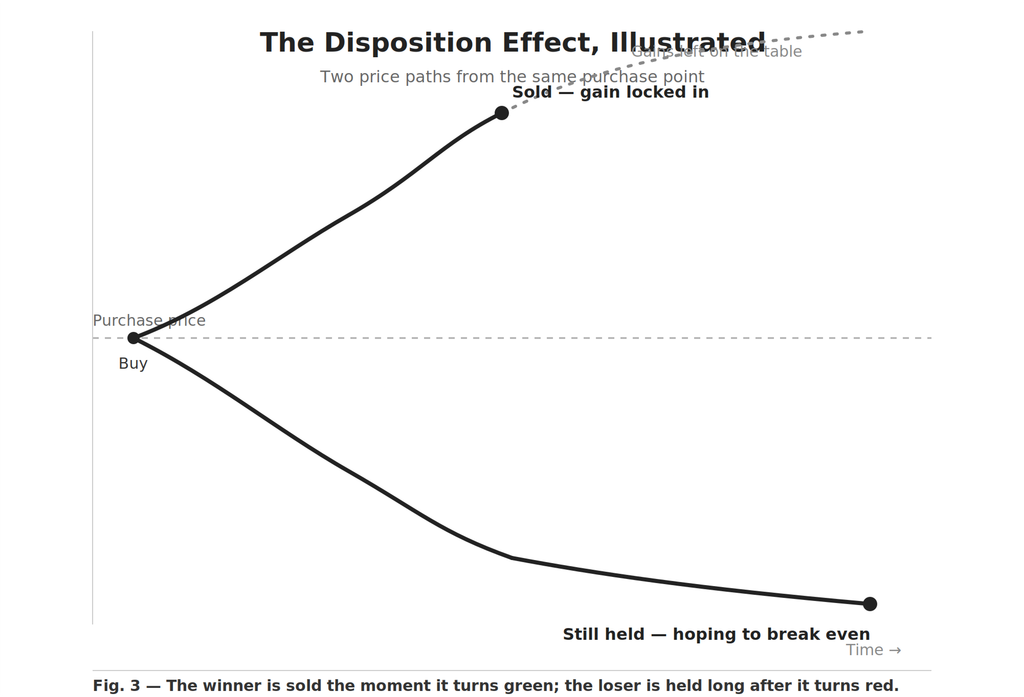
The pattern was unmistakable: investors sold their winning stocks far more often than their losing ones. But the real sting was in what happened next. The winning stocks they rushed to sell went on to outperform the market over the following year. The losing stocks they stubbornly held onto kept underperforming. Investors weren’t just exiting early, they were trading away their best-performing assets to keep their worst ones.
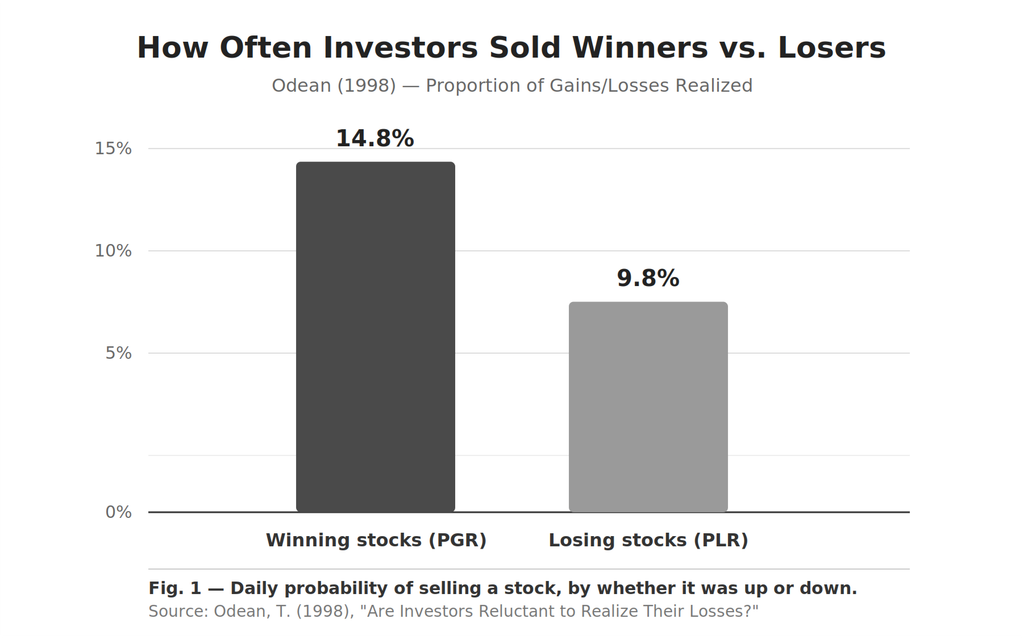
This wasn’t a new observation, either. More than a decade earlier, in 1985, two researchers named Hersh Shefrin and Meir Statman had already given this pattern a name: the disposition effect, a disposition, or tendency, to sell winners too early and ride losers too long. Odean’s data gave that name hard numbers.
The Psychological Mechanism
So why does a rational adult, fully capable of doing the math, keep making a trade that history says will cost them money?
The answer starts with how the human brain processes gains and losses, which, it turns out, is not symmetrical at all. In 1979, psychologists Daniel Kahneman and Amos Tversky (Kahneman would later win a Nobel Prize for this work) proposed what they called prospect theory. Their central finding: we feel the pain of a loss roughly twice as intensely as the pleasure of an equivalent gain.
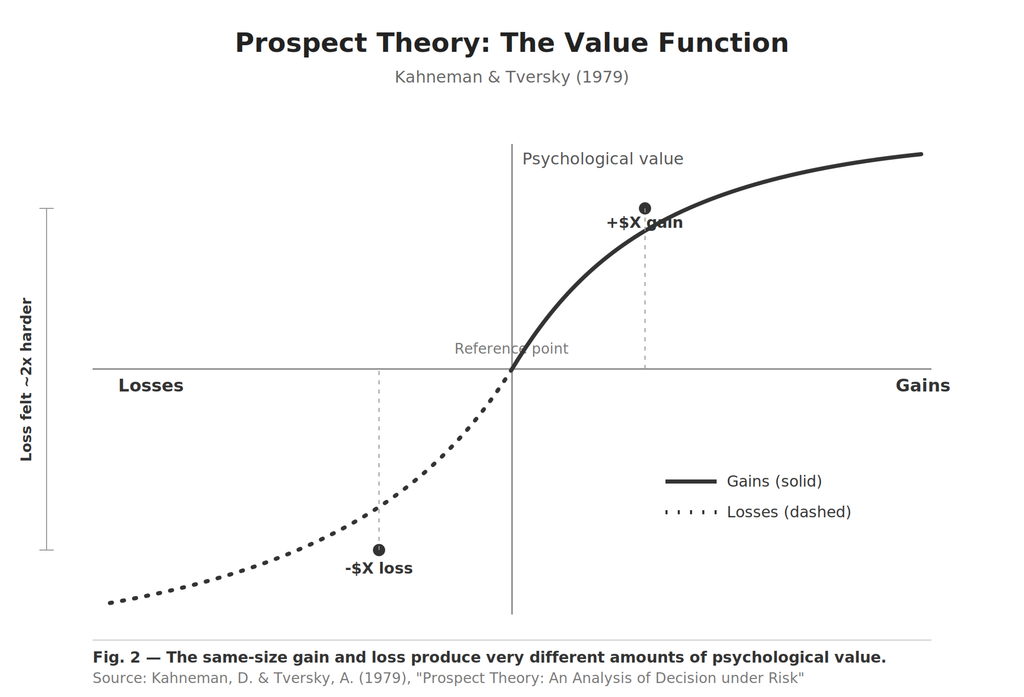
That imbalance changes our appetite for risk depending on which side of zero we’re standing on. When a stock is up, we become afraid of losing the gain we already have, so we play it safe and sell. When a stock is down, we can’t stomach making the loss real, so we take the riskier bet and hold on, hoping it recovers. In the green, we turn cautious. In the red, we turn into gamblers. Same person, same portfolio, two completely different risk appetites depending only on whether the number in front of them is positive or negative.
The Emotional Trigger
Prospect theory explains the shape of the bias. But there’s a more specific, moment-to-moment trigger that decides exactly when an investor pulls that sell (or hold) button and it comes down to accounting. Not the kind on a balance sheet. The kind that happens entirely in your head.
Economist Richard Thaler described this as mental accounting: the habit of treating every investment as its own separate ledger, mentally sealed off from the rest of your portfolio and your net worth. Here’s the catch: that mental account doesn’t « close, » psychologically, until the position is sold. A stock that’s down 20% isn’t a loss yet, as far as your brain is concerned, as long as you keep holding it. Selling is what makes it official.
That single moment carries an outsized emotional weight. Selling a winner closes the account with a win, a small, private burst of pride, proof that you were right. Selling a loser closes the account with a loss, an admission, on the record, that you were wrong. Given the choice, most people will delay the second kind of moment for as long as they possibly can, even at real financial cost.
The Myth That Won’t Die
There’s a story that gets passed around in investing circles that seems to confirm all of this, almost too perfectly. It goes: Fidelity once ran an internal study on which of its accounts performed best, and the answer was the accounts belonging to investors who had died. Second place went to people who had simply forgotten they had an account at all.
It’s a great story. It’s also not true.
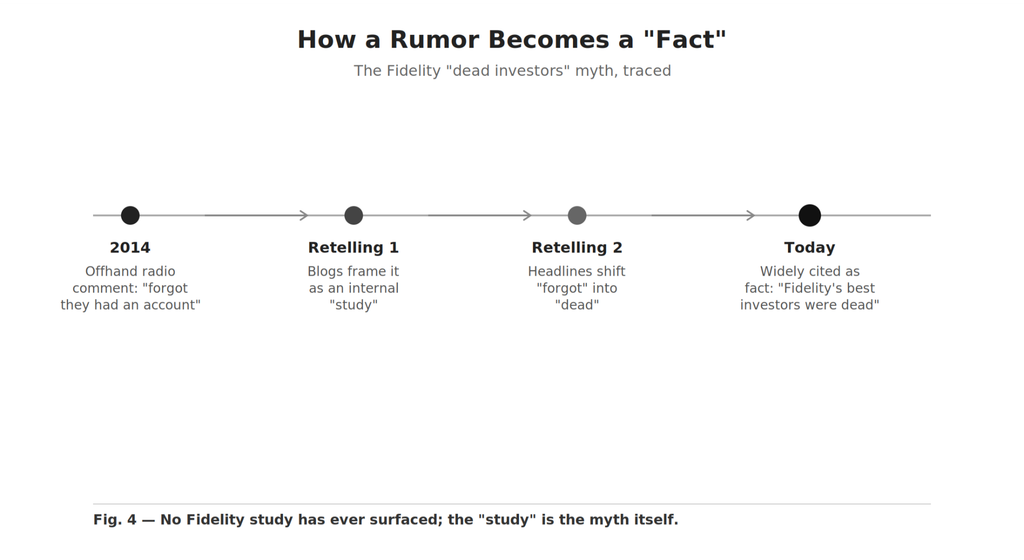
The tale traces back to a 2014 radio conversation between two market commentators, one of whom mentioned an offhand claim from an employee about dormant accounts outperforming. Somewhere between that conversation and the endless retellings since, « forgot they had an account » quietly became « dead, » and an anecdote became a widely cited « fact. » No such Fidelity study has ever actually surfaced.
The myth persists anyway, and that’s the interesting part. It endures because it captures something true even though the specific claim is false: the biggest threat to a portfolio usually isn’t the market, it’s the investor’s own hand reaching for the mouse.
The Fix
None of this means investors are doomed to keep repeating the mistake. Professional managers and disciplined individual investors get around it by removing the emotional decision from the moment entirely.
One method is the « blind portfolio » test: periodically ask yourself, if I didn’t already own this stock, would I buy it today at this price? If the answer is no, sell it, regardless of whether it currently shows a gain or a loss. The question strips away the mental account entirely and forces a decision based on the stock’s future, not its past performance relative to what you paid.
Another is simply removing the decision from human hands altogether, pre-set trailing stops, mechanical rebalancing rules, anything that executes the sale before the emotional override has a chance to kick in.
Closing
The market doesn’t decide when you win or lose money. Your reaction to the market does. Realize that, as Marcus Aurelius suggested two thousand years ago, and you already have more control over your returns than any chart or algorithm can offer you.
Sylvain Treutenaere
27 September 2026
References:
- Shefrin, H., & Statman, M. (1985). The Disposition to Sell Winners Too Early and Ride Losers Too Long: Theory and Evidence. The Journal of Finance, 40(3), 777–790.
- Odean, T. (1998). Are Investors Reluctant to Realize Their Losses? The Journal of Finance, 53(5), 1775–1798.
- Kahneman, D., & Tversky, A. (1979). Prospect Theory: An Analysis of Decision under Risk. Econometrica, 47(2), 263–292.
- Thaler, R. H. (1999). Mental Accounting Matters. Journal of Behavioral Decision Making, 12(3), 183–206.